Transferring to Mechanical Engineering - Personal Experience and FAQ
2025 cohort, Mechatronics Engineering, fish
Mechanical transfer chat group: 238483743
Introduction to the School of Mechanical and Automotive Engineering and My Journey
The School of Mechanical and Automotive Engineering at SCUT mainly has three majors: Mechatronics Engineering, Mechanical Engineering, and Intelligent Vehicle Engineering (I do not know much about Safety Engineering, Process Equipment and Control Engineering, or Material Forming and Control Engineering). Compared with the other two, Mechatronics has some extra electronics courses, such as Circuits, Digital Electronics, and Analog Electronics, so the course load is a bit heavier. If you want to find a job right after your bachelor's, choose Mechatronics; if you plan to pursue graduate studies, the three majors differ little — you can check the curricula on the official website. For students transferring out of Computer Science, Software, Automation, Information Engineering, and Electrical, Mechanical feels like the best choice. Welcome to the School of Mechanical and Automotive Engineering!
For the 2025 cohort, because most people chose Mechanical during the academician class (院士班) stream split, the split within the school caused the transfer policy to tighten, making the transfer situation very different from previous years. The requirements were Advanced Math ≥ 90 and English ≥ 85 (a big jump from the 2024 threshold), which screened out many people — the number of applicants never exceeded the number of acceptance slots. Back then I felt Computer Science, Software, Automation, Information Engineering, and Electrical were too cutthroat, and I badly wanted to escape my "天坑" (dead-end) major. On top of that, the raised threshold meant less competition. Also, compared with other majors, Mechanical has many competitions to join, such as RM, RC, ACM, Formula Student, Smart Car, the Engineering Training Contest, and the Electronic Design Contest, and the academic pressure is not very heavy, so there is more time for competitions. In the School of Mechanical and Automotive Engineering you can learn hands-on, practical things and become an engineer. Of course, Mechanical involves a lot of drawing (you can search "mechanical engineering drawing" online) and mechanics, such as Mechanics of Materials and Theoretical Mechanics — before transferring, think carefully about whether you can accept that. Some Mechanical students have transferred out precisely because they disliked drawing or could not get the hang of mechanics. In short, the make-up coursework pressure of transferring is considerable, and things are hard both before and after the transfer. A major transfer is a challenge in itself, and daring to take it on is already great!
Transfer Requirements
At the end of April, each school publishes its transfer admission requirements, which can be seen on each school's official website. In 2025 the School of Mechanical and Automotive Engineering was one of the later ones — the document came out right before the May Day holiday (五一). I advise students planning to transfer to use the May Day holiday to prepare well. Since Mechanical is interview-only, the only channels for getting to know you are the interview PPT and your weighted average. Study hard in the first semester of freshman year and push your math and English grades — it pays off either way, whether or not the transfer succeeds. If your weighted average is not very high, I suggest putting some Mechanical-related skills in your PPT, such as SW (SolidWorks) and AutoCAD — must-know software for mechanical engineers; having these two gets you most of the way there. I taught myself SolidWorks at the time and put a few modeling screenshots in my PPT. You can learn SolidWorks over the May Day break; relevant project experience also works, and competitions you have entered can go in as well (math competitions, or even "水赛" (easy, low-threshold contests), are fine).
About Transfer Success Rates
Major Slots Applicants Admitted Same-grade Transfers Application-to-Admission Ratio
Mechatronics Engineering 18 18 13 8 0.72 Mechanical Engineering 23 18 18 9 1 Intelligent Vehicle Engineering 18 5 3 3 0.6
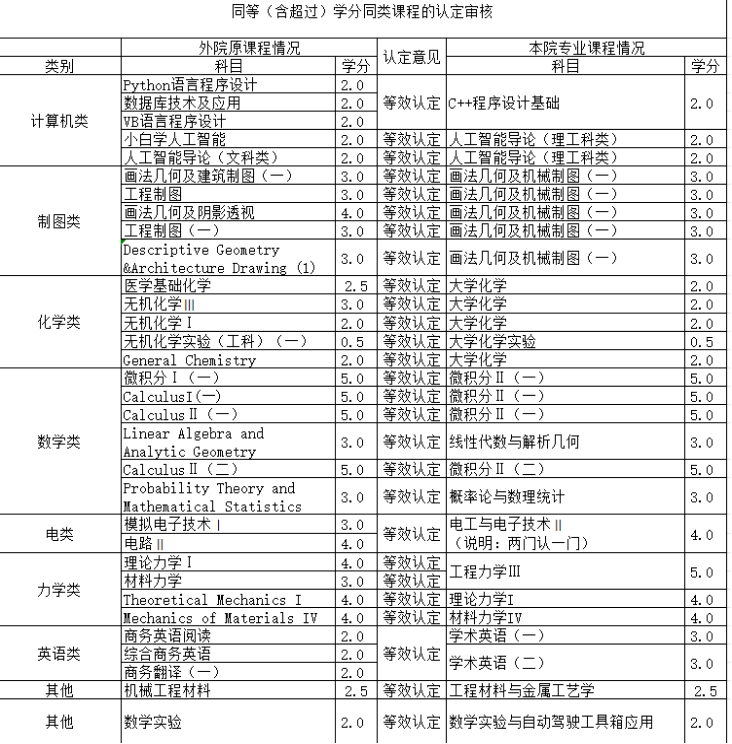
To sum up, the Mechanical Engineering interview does not cut people, while Mechatronics and Intelligent Vehicle both prefer vacancies over unqualified candidates. As for whether Mechanical discriminates against liberal arts students, and whether liberal arts students can choose a grade-down transfer (降转): in the 2025 cohort Mechatronics admitted one of three liberal arts applicants, Intelligent Vehicle had no liberal arts applicants, and Mechanical Engineering cut no one. In short, liberal arts students who are excellent enough can also apply to Mechanical. The academic affairs officer said at the time that whether a grade-down transfer applies is decided by the school based on credit recognition (学分认定). According to the full set of 2025 transfer documents, no liberal arts students received same-grade transfers (平转), so liberal arts students who want a same-grade transfer should think carefully.
Transfers into the 2025 cohort (majors not requiring a grade-down)
Outgoing Major Outgoing School Count Smart Transportation School of Civil Engineering and Transportation 6 Biopharmacy School of Food Science and Engineering 3 Energy Chemical Engineering School of Light Industry Science and Engineering 3 Food Science and Engineering School of Food Science and Engineering 3 Naval Architecture and Ocean Engineering School of Civil Engineering and Transportation 1 Bioengineering School of Food Science and Engineering 1 Materials Science and Engineering School of Materials Science and Engineering 1 Engineering Mechanics School of Civil Engineering and Transportation 1 Biotechnology School of Biology and Biological Engineering 1 Transfers into the 2026 cohort (majors requiring a grade-down)
Outgoing Major Outgoing School Count Industrial Design School of Design 5 Public Administration School of Public Administration 2 Business English School of Foreign Languages 2 "Urban and Rural Planning + Big Data Management and Application" Double Degree School of Architecture 1 Architecture School of Architecture 1 Communication Studies School of Journalism and Communication 1 Clinical Medicine School of Medicine 1 Tourism Management Department of Tourism Management 1
(The data above is compiled from the overall 2025 transfer list; some students may have chosen the grade-down option on their own initiative — for reference only.)
Transfer Process
After registration closes, around the May Day holiday you will receive the interview notification by phone, and an interview announcement will come out in the academic affairs system shortly after (note: not on the school's website). After joining the Mechanical transfer interview group, the day before the interview there is a draw to decide the interview order, and you email your interview PPT to the academic affairs teacher. The interview may start quite early — around eight or nine in the morning. Everyone waits in one classroom, and the teachers call people in (a bit like a queue-number system).
The waiting is agonizing, so be prepared for it — though you can also ask the people ahead of you what the teachers asked them. I was the last one that day. Sitting late in the order means a long wait, but it does help break some information gaps. The interview is a 5-minute self-introduction plus 5 minutes of questions, with a timer on the screen — do not run over time. The questions are mainly based on what is in your PPT, so do not write random things in it and do not oversell yourself too much; they may probe every single detail. The teachers were generally quite kind. They may ask some rather hard questions — do not be nervous; being open and composed is good enough. Feel free to go all out against the teachers (jk). And if you are asked whether you can accept a grade-down transfer, do not be nervous either — engineering majors do not have grade-down transfers.
Attached are the interview PPT requirements: the personal statement lasts 5 minutes and is delivered with a PPT. The content mainly covers your basic personal and family situation, basic academic status, your reasons for applying for the transfer and your understanding of the target major, your academic plans going forward, your outstanding personal potential, hobbies and strengths, and so on. It mainly assesses the student's awareness of the target major, innovative thinking, mastery of the public foundation courses, ability to complete the degree, willingness and aspiration to work in the field in the future, and psychological resilience, among other things.
Possible Interview Questions
Mechatronics interview questions: my first question was whether I could accept a grade-down transfer (the tone was so stern it scared me QAQ). Then they asked about the SolidWorks modeling shown in my PPT, the working principle of a gearbox (I knew something about this, and the teachers seemed quite satisfied), and how I did the modeling. Later they asked whether I had learned any programming and whether I knew anything about the electricity-related courses.
According to other students, questions also included: 1. The role of eigenvectors in mechanical engineering 2. How to prove the conservation of mechanical energy (linking it with calculus) 3. What is the difference between digital circuits and analog circuits? Give one example from a mechatronic system for each 4. The differences between linear algebra, analytic geometry, and calculus 5. Mechanics and mechanical energy in University Physics — related knowledge 6. Is mechanical energy a state quantity? 7. Have you considered other majors? 8. What preparation have you made for transferring into Mechatronics?
Mechanical Engineering interview questions: 1. There was a hypercube in my PPT, and he asked me a question based on my PPT. 2. Your major ranks very high at SCUT — why come choose Mechanical? 3. Have you done any mechanical-related projects? 4. What is the use of linear algebra? 5. Why transfer into this major? 6. If you transfer into this major, what kind of work do you want to do?
Intelligent Vehicle interview questions: 1. Why choose Vehicle Engineering? Why not transfer to Automation?
What is the object of study of Theoretical Mechanics?
When a car is braking, is it better to brake to a full stop in one go, or to brake with light, repeated presses?
How does what you learned in your original major help you transfer into Intelligent Vehicle Engineering? What connections does your original major have with Intelligent Vehicle Engineering?
During your time interning with the racing team, what work did you do?
(Compiled from fragments of classmates' recollections — not very specific, for reference only.)
Conclusion
Transferring majors takes great determination and a lot of hard work. I hope that in the first semester of freshman year and before the transfer you can keep working hard and stay firm on your goal. Whether it succeeds or not, and whichever major you end up in, transferring is an experience and a tempering that challenges yourself — you can learn a lot from it, and also summarize and reflect on your own shortcomings. No matter which major you are in afterwards, you need to keep grinding, grinding, and grinding. Finally, I wish everyone success in transferring, and welcome to the School of Mechanical and Automotive Engineering!
(Attached: the Mechanical credit recognition table)