Transferring to Information Engineering - Experience Sharing
(School of Electronic and Information Engineering transfer group number: 1037507331)
I. Choice
Since you have clicked into this article, I will get straight to the point:
If you feel you can accept your current major, then you can reasonably take a shot at the popular engineering majors with fierce competition (Computer Science, Software, Information Engineering, Automation, Electrical, plus Mechanical and Automotive). These popular engineering majors generally have very high application-to-admission ratios, intense competition, and an even higher risk of failure.
If you cannot accept your current major and its situation is truly terrible, then you should weigh your own circumstances carefully when deciding. Although the popular engineering majors do offer better prospects, their failure rates are genuinely higher. You can look at other engineering majors (Energy and Power, Materials, etc.) — first make sure you can get out at all. If you fail to get out in your first year, the pressure will be much greater whether you go for a grade-down transfer (降转) in your second year or sit the postgraduate entrance exam in a different field.
Of course, as for how to weigh risk against reward, you can judge based on your own situation.
Overview:
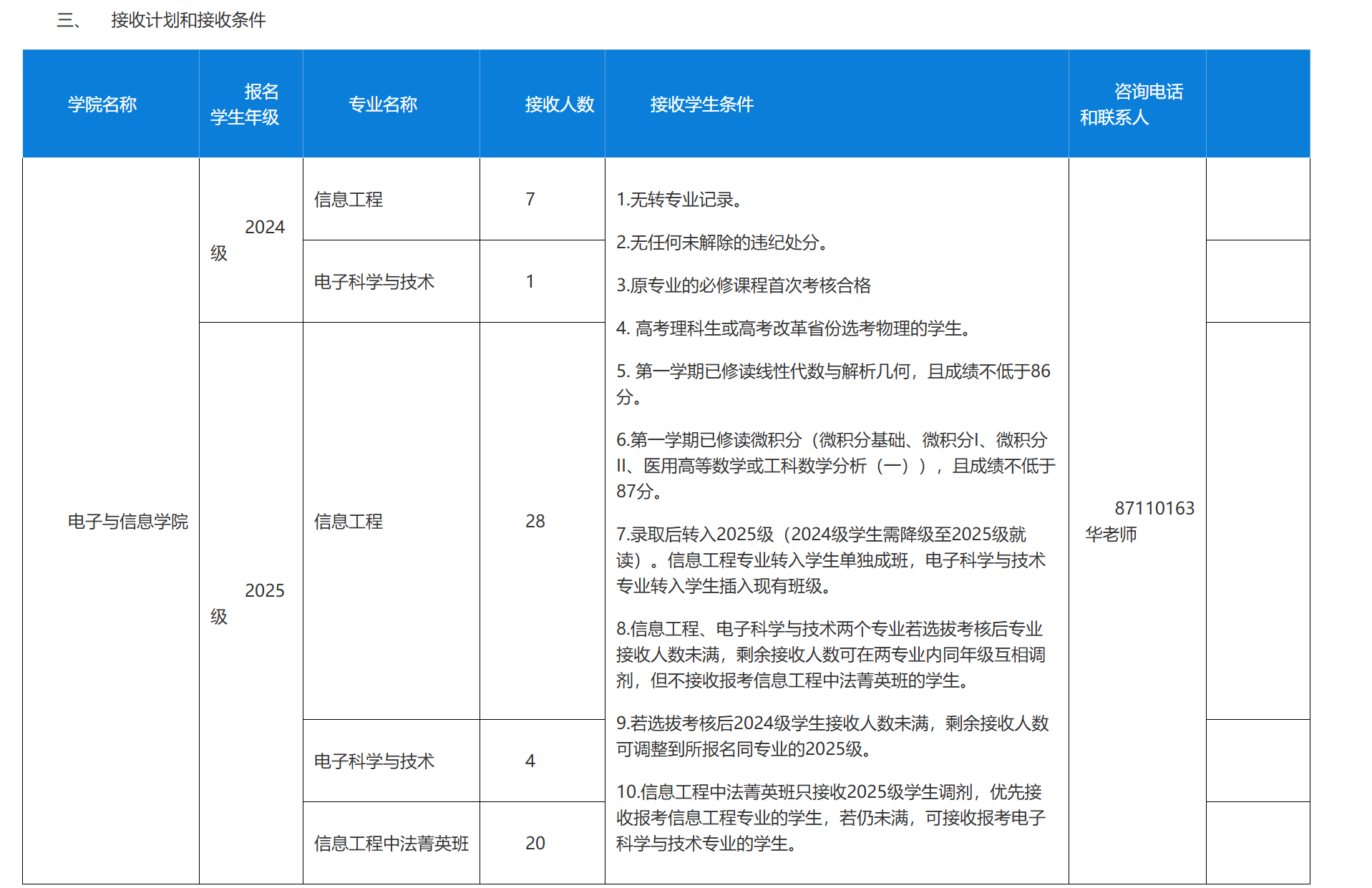
The transfer acceptance situation of the School of Electronic and Information Engineering is as follows:
Other reminders:
For the 2025 cycle, the Sino-French class (中法班) was not offered because there were not enough applicants, but the 2026 cycle still has an admission plan for the Sino-French class. For details, ask in the School of Electronic and Information Engineering transfer group.
III. Process
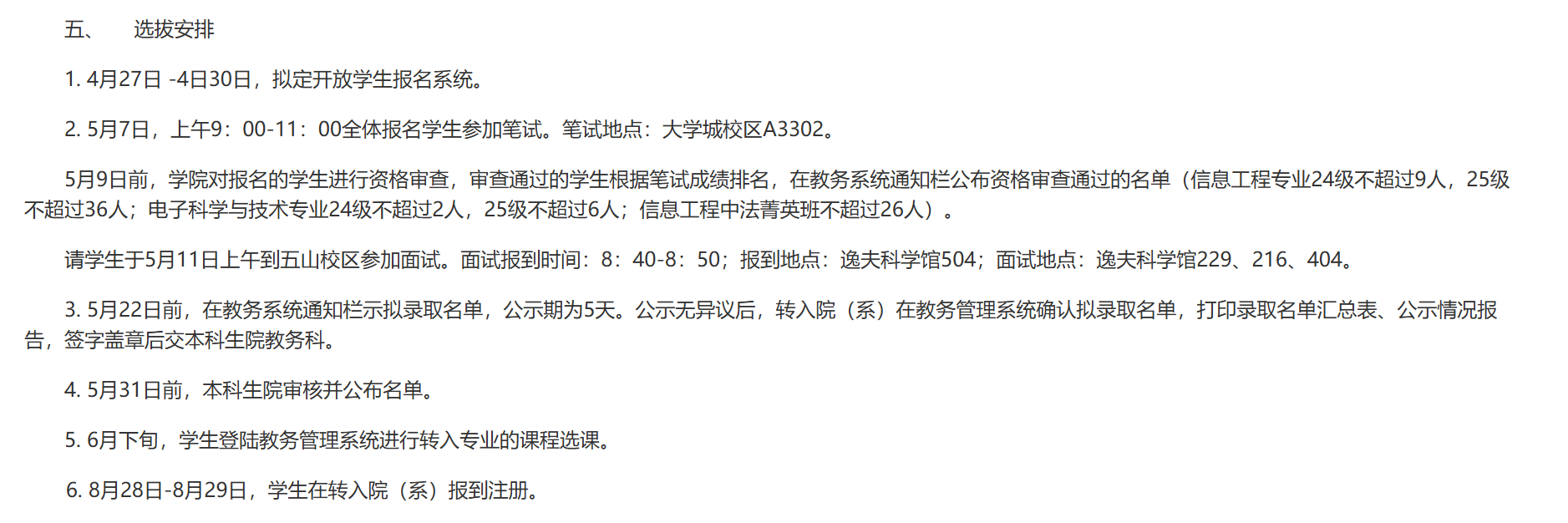
The general process is as follows:
Other reminders:
The number of applicants can be seen on the major transfer application page (only before applications close — after that it is no longer visible; if someone in the transfer group has tallied the numbers, you can check it in the group).
IV. Specific Preparation
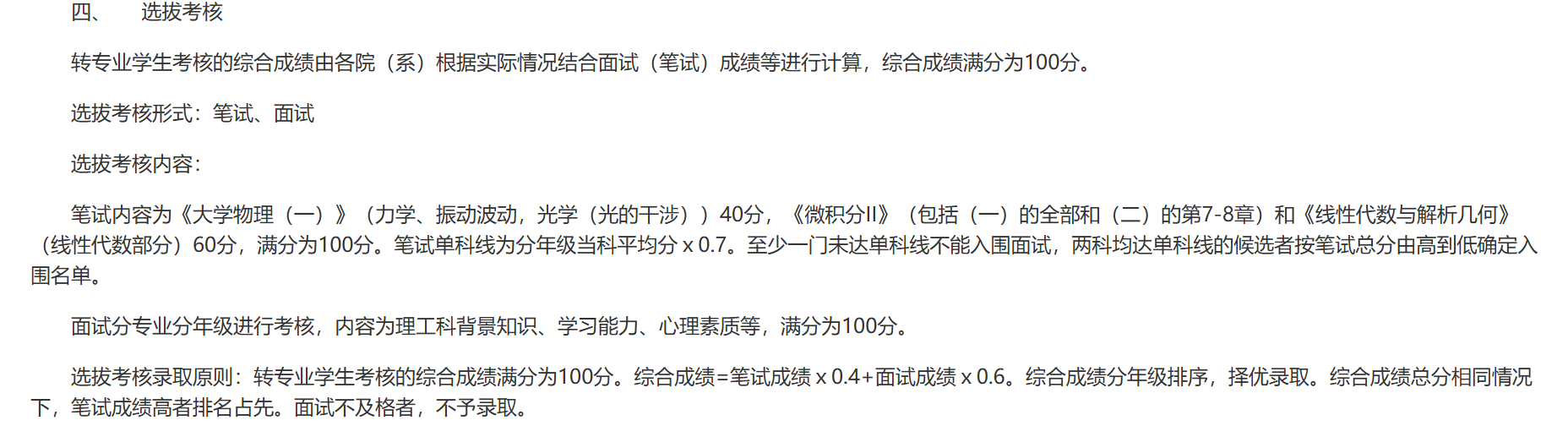
Transferring into Information Engineering consists of a written exam and an interview:
The written exam (around May 7 in the spring semester of freshman year) — requirements are shown in the image below.
How to divide up the preparation work:
In the first semester of freshman year, the main preparation is to raise your Advanced Math, Linear Algebra, and overall GPA as much as possible.
Over the freshman-year winter break, you can do some light practice to keep your feel for Advanced Math and Linear Algebra.
In the spring semester, the main focus should be studying Advanced Math II and University Physics seriously (do not completely drop your other major courses like Probability Theory either, or you will suffer at finals). Around mid-April you can start grinding practice problems (University Physics, Linear Algebra, Advanced Math).
Usually the teachers can finish covering the courses within the transfer exam scope before the written exam, but the time left for review and problem grinding may not be enough, so it is still advisable to preview ahead of time and leave yourself enough time.
Notes on exam content:
In the 2025 written exam, the Advanced Math and University Physics questions were fairly standard — practicing past papers is enough.
But Linear Algebra was tested very hard, every bit as difficult as the final exam if not more. The big questions had none of the usual formulaic positive-definite-matrix problems; instead there was one capstone proof question. It is hard to give a review strategy for that — just go over the material as usual.
Other reminders:
Calculators are allowed in the Information Engineering written exam. It is recommended to just buy a Casio calculator — you will need it for the University Physics final anyway. (Some Linear Algebra and University Physics problems may require a calculator.)
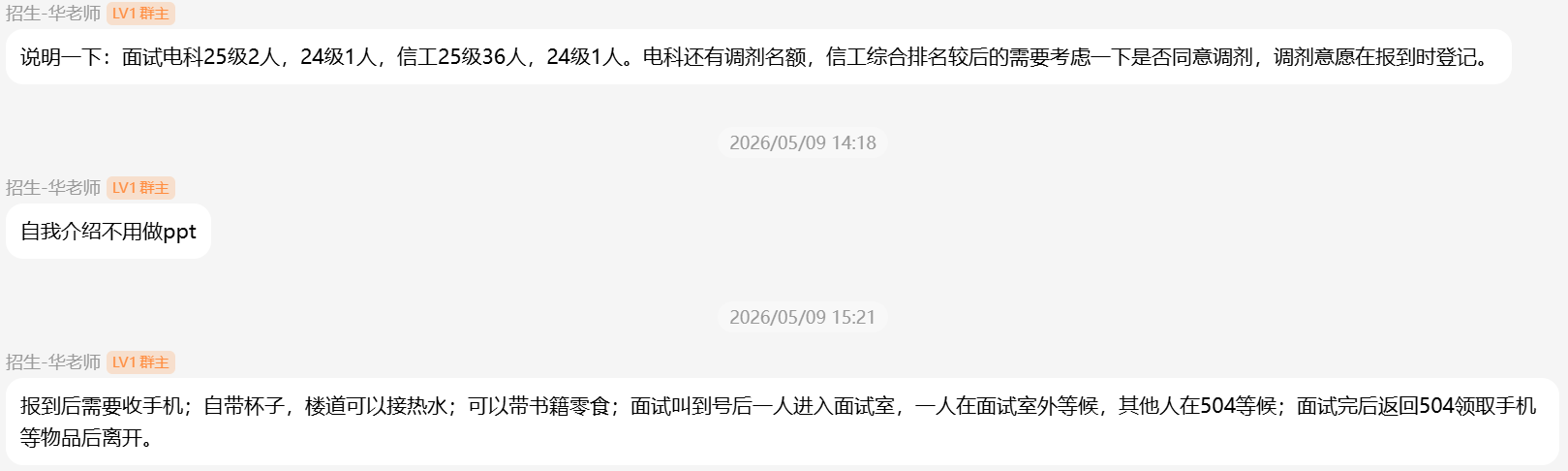
Interview (about a week after the written exam):
Requirements are shown in the image below:
How to divide up the preparation work:
After the written exam you have less than a week to prepare for the interview. For the self-introduction part, you can talk about your study methods, the SRP (Student Research Program) project you participated in, and so on — just write it according to your own situation. (You can mention your CET-4 score and your Gaokao score and provincial ranking; they seemed to ask about those quite a lot.)
The teachers ask questions based on your self-introduction — in my case they asked about my SRP project and some of my hobbies. The interview is mostly about your ability to think on your feet, so just relax and answer naturally.
Other reminders:
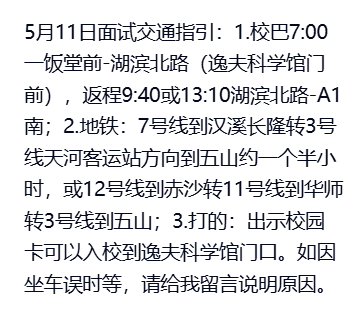
On interview day you need to go to the Wushan Campus. You can take the metro, the campus bus, or a taxi — as shown in the image:
V. Conclusion
Having read this article, whether you have decided on a different major based on your own situation or have solidified your goal of transferring into the School of Electronic and Information Engineering, I sincerely wish you success. Everyone who transfers majors may have their own unspoken reasons, and this summer may not have been so beautiful. But you still finished reading this article — I hope it can put a perfect full stop at the end of the story. So plant a seed, and look forward to the harvest a year from now — and this article is my harvest.
Wishing everyone a smooth transfer and a brilliant future!
Image Materials